 English
 Russian
 German
 French
 Italian
 Spanish
 Partuguese
 Greek
 Japanese
 Korean
 Turkish
 Polish
 Arabic

What Is Fiber Optic Cable?
Introduction
Fiber optic cable is a high-speed data transmission medium that uses light signals to carry information through thin strands of glass or plastic fibers. Compared with traditional copper cables, fiber optic cables provide significantly higher bandwidth, faster transmission speeds, and longer communication distances.
Today, fiber optic technology forms the backbone of modern communication networks such as internet infrastructure, telecommunications systems, data centers, and FTTH (Fiber to the Home) networks.
Professional manufacturers such as ANFKOM produce fiber optic cables and components that enable high-speed connectivity for global networks.
Structure of Fiber Optic Cable


A fiber optic cable consists of several protective layers designed to guide light signals and protect the delicate fiber inside.
Main Components
Core
The core is the central part of the fiber where light signals travel. It is usually made from ultra-pure glass or plastic.
Cladding
The cladding surrounds the core and has a lower refractive index. This allows light signals to reflect back into the core through total internal reflection.
Coating / Buffer
This protective layer shields the fiber from moisture, bending, and mechanical damage.
Strength Members
Materials such as Kevlar provide additional mechanical strength to prevent fiber breakage.
Outer Jacket
The outer jacket protects the cable from environmental damage, chemicals, and abrasion.
How Fiber Optic Cable Works
Fiber optic cables transmit data using pulses of light instead of electrical signals.
The transmission process includes three key components:
-
Transmitter – converts electrical signals into light signals using LEDs or lasers
-
Optical Fiber – carries the light signals through the network
-
Receiver – converts light signals back into electrical data
Because light travels extremely fast and experiences very little signal loss, fiber optic cables can transmit information over very long distances with minimal interference.
Types of Fiber Optic Cable
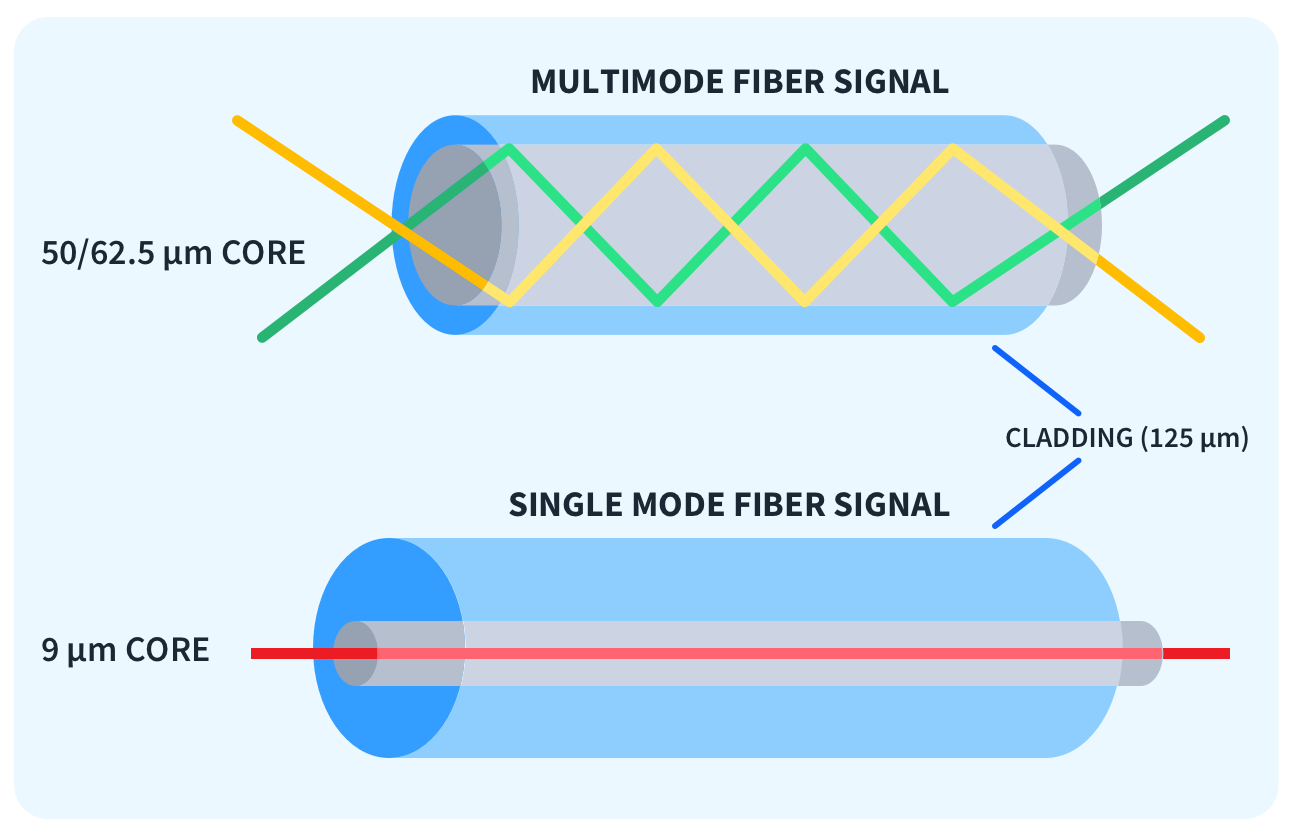

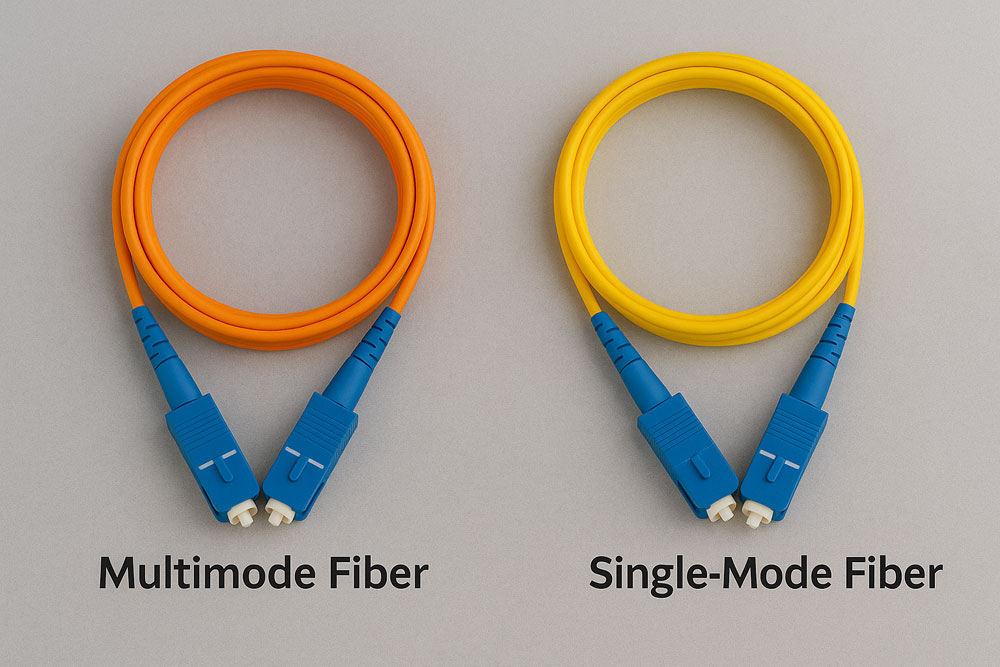
Fiber optic cables are mainly divided into two categories based on how light travels through the fiber.
1. Single Mode Fiber (SMF)
Single mode fiber has a very small core diameter (about 8–10 microns), allowing light to travel in a single path.
Characteristics:
-
long transmission distance
-
high bandwidth
-
low signal loss
Applications:
-
telecommunications networks
-
long-distance internet backbone
-
FTTH broadband networks
Single mode fiber is commonly used in large-scale communication systems.
2. Multimode Fiber (MMF)
Multimode fiber has a larger core diameter, allowing multiple light paths to travel simultaneously.
Characteristics:
-
shorter transmission distance
-
lower cost optical equipment
-
suitable for local networks
Multimode fiber types include:
-
OM1
-
OM2
-
OM3
-
OM4
-
OM5
Applications include:
-
data centers
-
enterprise networks
-
local area networks (LAN)
Advantages of Fiber Optic Cable
Fiber optic cables offer several advantages compared with traditional copper cables.
Higher Bandwidth
Fiber cables support extremely high data speeds required for modern applications such as cloud computing and high-definition video streaming.
Longer Transmission Distance
Signals can travel tens or even hundreds of kilometers without significant signal loss.
Faster Data Transmission
Because fiber uses light instead of electrical signals, data transmission speeds are significantly faster.
Immunity to Electromagnetic Interference
Fiber optic cables are not affected by electromagnetic interference, ensuring stable communication.
Improved Security
Fiber networks are more secure because it is difficult to tap or intercept optical signals.
Lightweight and Compact
Fiber cables are thinner and lighter than copper cables, enabling high-density installations.
Applications of Fiber Optic Cable
Fiber optic cables are widely used across many industries.
Telecommunications
Fiber forms the backbone of global telecom infrastructure, enabling high-speed internet and voice communication.
Data Centers
Modern data centers rely on fiber optic cabling to support high-speed data transfer between servers and storage systems.
FTTH Networks
Fiber-to-the-home networks deliver ultra-fast internet directly to residential homes.
Enterprise Networks
Businesses use fiber cables for internal communication networks that require high reliability and bandwidth.
Industrial Applications
Fiber optics are used in harsh environments where electrical interference could disrupt copper cables.
Future of Fiber Optic Technology
With the growth of cloud computing, 5G networks, artificial intelligence, and big data, demand for high-speed communication infrastructure continues to increase.
Fiber optic cables are essential for supporting technologies such as:
-
5G mobile networks
-
hyperscale data centers
-
smart cities
-
IoT systems
Manufacturers like ANFKOM continue to develop advanced fiber optic solutions to support next-generation communication networks.
Conclusion
Fiber optic cable is one of the most important technologies powering modern communication networks. By transmitting data through light signals in glass fibers, it provides unmatched speed, bandwidth, and reliability.
From telecommunications infrastructure to data centers and FTTH broadband systems, fiber optic technology plays a crucial role in enabling global digital connectivity.
As internet demand continues to grow worldwide, fiber optic cables will remain the foundation of future communication systems.


